MENU
FR | EUR
-
-
-
- Service pour pipette
- Services pour Mastercycler
- Services pour automates de pipetage
- Services pour bioprocédés
- Services pour congélateurs
- Services pour incubateurs
- Services de qualification
- Services pour agitateurs
- Service de contrôle de la température et de l’agitation
- Services pour centrifugeuse et rotors
-
-
- WHX Labs Dubai 2026
- analytica 2026
- Forum Labo 2026
- SLAS Europe 2026
- Forum Labo 2026 Bioprocess
- Bioprocessing Summit Europe 2026
- BioProcess International 2026
- Swiss Biotech Day 2025
- ISCT 2026
- Pichia 2026
- Future Labs Live 2026
- BioProScale Sympposium 2026
- ASGCT 2026
- Eppendorf Automation Forum 2026
- ESACT 2026
- ECB 2026
- WoTS 2026
- SIMB Annual Meeting 2026

-
-
-
- Service pour pipette
- Services pour Mastercycler
- Services pour automates de pipetage
- Services pour bioprocédés
- Services pour congélateurs
- Services pour incubateurs
- Services de qualification
- Services pour agitateurs
- Service de contrôle de la température et de l’agitation
- Services pour centrifugeuse et rotors
-
-
- WHX Labs Dubai 2026
- analytica 2026
- Forum Labo 2026
- SLAS Europe 2026
- Forum Labo 2026 Bioprocess
- Bioprocessing Summit Europe 2026
- BioProcess International 2026
- Swiss Biotech Day 2025
- ISCT 2026
- Pichia 2026
- Future Labs Live 2026
- BioProScale Sympposium 2026
- ASGCT 2026
- Eppendorf Automation Forum 2026
- ESACT 2026
- ECB 2026
- WoTS 2026
- SIMB Annual Meeting 2026
FR | EUR
-
- Pipettes, distributeurs et dispositifs de manipulation de liquides automatisée
- Pipettes mécaniques
- Pipettes électroniques
- Pipettes multicanaux
- Pipettes et distributeurs à déplacement positif
- Pointes de pipette
- Distributeurs sur flacon
- Auxiliaires de pipetage
- Accessoires pour pipettes et distributeurs
- Pipetage automatisé
- Consommables d’automatisation
- Accessoires d’automatisation
- Services pour pipettes et distributeurs
Sorry, we couldn't find anything on our website containing your search term.
Sorry, we couldn't find anything on our website containing your search term.
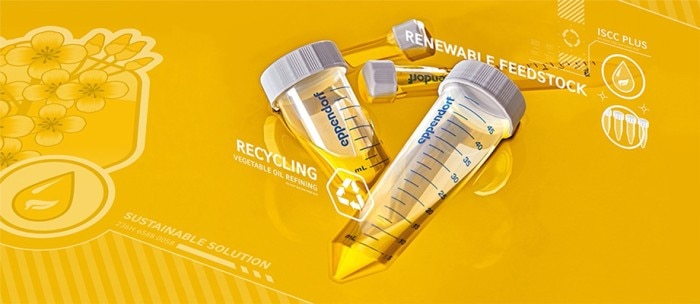
2nd Generation Feedstock – 1st Class Consumables
BRIGITTE KLOSE Lab Academy
- Microbiologie
- Biologie moléculaire
- Durabilité
- Cuves
- BioNews article
Imagine that your laboratory tube could be manufactured from renewable raw materials, as well as from waste and residues generated by the vegetable oil industry. Would you have faith in the quality of the product? Would you depend on the purity and reliability of the tube and entrust it with your valuable samples – in the same way that you have always trusted your tube made from fossil raw materials? If this thought has piqued your interest, continue reading.
This article appeared first in BioNews, Eppendorf’s application-oriented customer magazine since 1993.
Plastic vessels manufactured from fossil raw materials have long replaced glass containers in the laboratory and have become irreplaceable. With respect to sustainability, this constitutes a considerable challenge, for laboratories and manufacturers alike. We have therefore made it our goal to produce high-quality plastic products for the laboratory in a more sustainable fashion and employ renewable resources of the second generation in the process.
From used vegetable oil to top-quality laboratory consumables
When selecting alternative, more sustainable materials, our plastic experts decided in favor of a biobased polymer which is produced from renewable, reused raw materials such as, for example, used cooking oil. The Eppendorf Tubes® BioBased manufactured from these raw materials are a new generation of vessels that allow us to help you achieve your sustainability goals.
Biobased polymer – what exactly is it?
With the biobased polymer chosen by Eppendorf, fossil raw materials are saved through their replacement with sustainable raw materials made from waste materials and residues of used cooking oil (also known as “second generation biofuels”). These raw materials are traceable to the first oil collection facility. The production of this polymer is certified with the sustainability certificate “ISCC PLUS”. With an ISCC PLUS certification, companies ensure that the entire supply chain, from cultivation to the final product, has been audited.
ISCC supports the transition to a circular economy and bioeconomy, bringing with it many advantages such as the traceability of the entire supply chain, authentication of the identity of raw materials, clear information verified by third parties, and the strengthening of consumer trust through an independent certification system.
No compromise
Eppendorf Tubes BioBased are equal to fossil-based Eppendorf Tubes with respect to both quality and performance. All quality guarantees issued with our product-specific, as well as lot-specific certificates are equally valid for Eppendorf Tubes BioBased. The switch to Eppendorf Tubes BioBased does not pose a risk to your samples or your experimental data.
Plastic vessels manufactured from fossil raw materials have long replaced glass containers in the laboratory and have become irreplaceable. With respect to sustainability, this constitutes a considerable challenge, for laboratories and manufacturers alike. We have therefore made it our goal to produce high-quality plastic products for the laboratory in a more sustainable fashion and employ renewable resources of the second generation in the process.
From used vegetable oil to top-quality laboratory consumables
When selecting alternative, more sustainable materials, our plastic experts decided in favor of a biobased polymer which is produced from renewable, reused raw materials such as, for example, used cooking oil. The Eppendorf Tubes® BioBased manufactured from these raw materials are a new generation of vessels that allow us to help you achieve your sustainability goals.
Biobased polymer – what exactly is it?
With the biobased polymer chosen by Eppendorf, fossil raw materials are saved through their replacement with sustainable raw materials made from waste materials and residues of used cooking oil (also known as “second generation biofuels”). These raw materials are traceable to the first oil collection facility. The production of this polymer is certified with the sustainability certificate “ISCC PLUS”. With an ISCC PLUS certification, companies ensure that the entire supply chain, from cultivation to the final product, has been audited.
ISCC supports the transition to a circular economy and bioeconomy, bringing with it many advantages such as the traceability of the entire supply chain, authentication of the identity of raw materials, clear information verified by third parties, and the strengthening of consumer trust through an independent certification system.
No compromise
Eppendorf Tubes BioBased are equal to fossil-based Eppendorf Tubes with respect to both quality and performance. All quality guarantees issued with our product-specific, as well as lot-specific certificates are equally valid for Eppendorf Tubes BioBased. The switch to Eppendorf Tubes BioBased does not pose a risk to your samples or your experimental data.
Lire la suite
Related documents
- Magazine | BioNews 58 (January 2023)
- White Paper: Consumables Made of Bioplastics enter the lab
Lire la suite